by An’Zel Allen
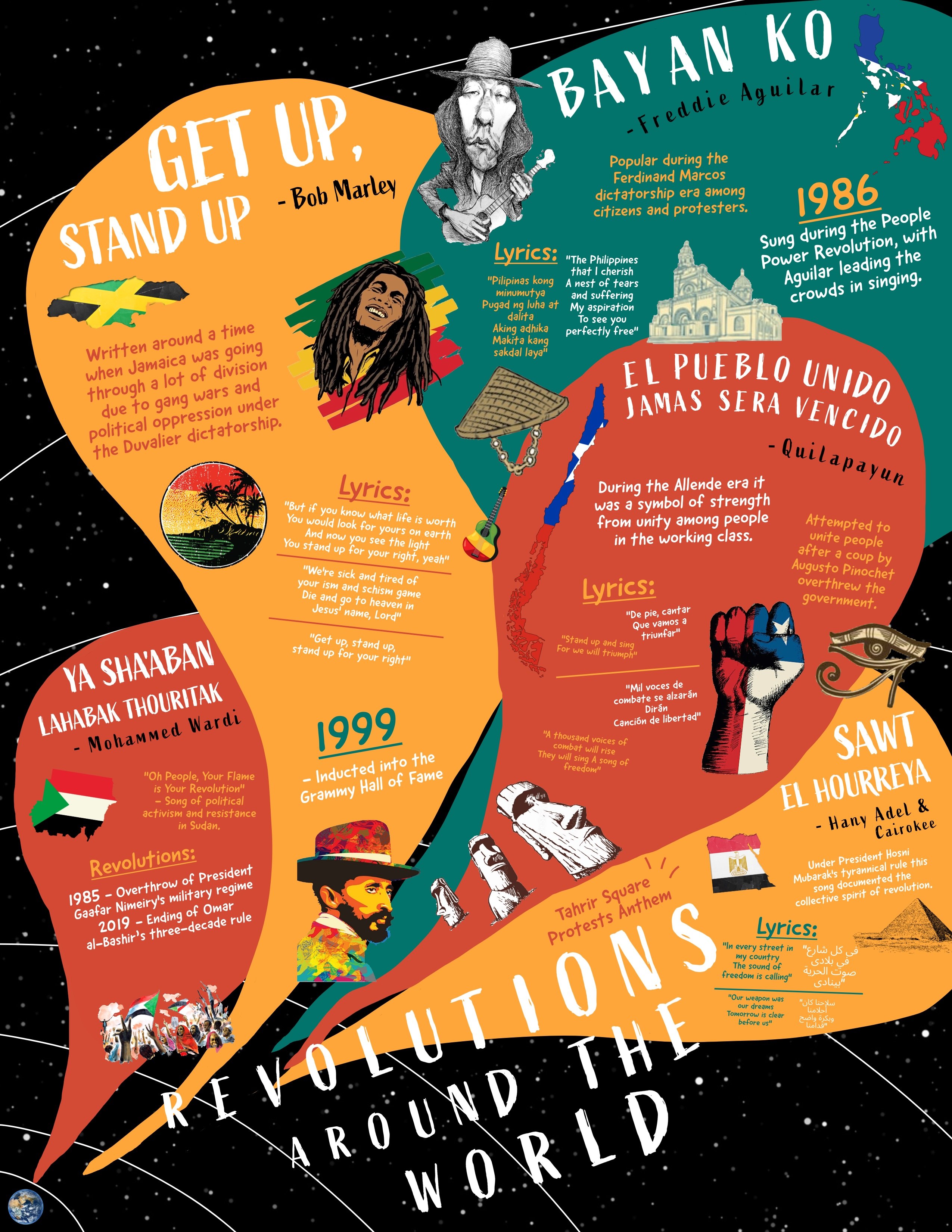
Revolutions was my initial topic of interest for English 1102 Artifact 1. Initially, I was going to use a Kendrick Lamar song or “The Revolution Will Not Be Televised” by Gil Scott-Heron, but I felt these songs were too narrow-minded and focused on America. So, I decided to broaden the topic to “Revolutions Around the World”. I began my playlist with the Jamaican song “Get Up, Stand Up,” by Bob Marley because of my personal connection with being Jamaican. Bob Marley was influenced to create the song while he was on tour in Haiti and witnessed their oppression during the Duvalier Dictatorship. In the song he urges the people of Haiti and Jamaica, which was undergoing gang violence, to stop waiting for someone to save them and fight for their own rights. The next song was “Ya Sha’aban Lahabak Thouritak,” by Mohammad Wardi centered around Sudan. He was a known activist and created this to inspire revolutionary change and dissuade a future military coup. This song was later used during the 2019 Sudanese Revolution ending Omar Al-Bashir’s three-decade rule. The third song was “Voice of Freedom,” by Hany Adel and Cairokee focused on Egypt. This song was sparked by the murder of Khaled Said, under the tyrannical rule of President Hosni Mubarak. This song was especially interesting because of its music video that depicted Egyptians during the middle of the Tahrir Square Protests singing the song capturing the collective expression of their dreams. The fourth song was “El Pueblo Unido Jamás Será Vencido,” by Quilapayún during the Allende Era in Chile. This song was made to be easily chantable and rhythmic so that it could unify the working class against a looming military threat. It became a symbol of unity and strength but unfortunately, after a coup by Augusto Pinochet who overthrew the government, it was prohibited. My last song was “Bayan Ko,” by Freddie Aguilar, which focused on the Filipinos. This song was originally a 1928 poem created to oppose American occupation but Aguilar created a folk rendition of it during the Marcos Dictatorship. The song describes the Filipino people as a bird trapped in a cage longing for its nest, symbolizing the citizens’ strive for sovereignty and an end to Martial Law. It was later used as an anthem during the People Power revolution, with Aguilar singing to crowds. Each song that I added for this playlist was used to characterize or influence some sort of revolution or unrest in its respective country. So, my goal was to capture the uniqueness of each country and their similar feelings through my infographic. That is why each country has a respective section illustrating how different they are while still being connected to the Earth in the bottom left. This simply shows how everyone, no matter where we are from, is human and deserves to be treated as such. It also goes to show how influential music can be for inspiring people and acting as a memory of the collective expression of a country or movement.